When I first opened the competitive tab in Valorant, the ladder felt like alphabet soup — Iron, Ascendant, Radiant, and a Rank Rating number that went up and down for reasons I didn't understand. This guide lays the whole system out plainly, so you know exactly where you stand and what it takes to move up.
Key Takeaways
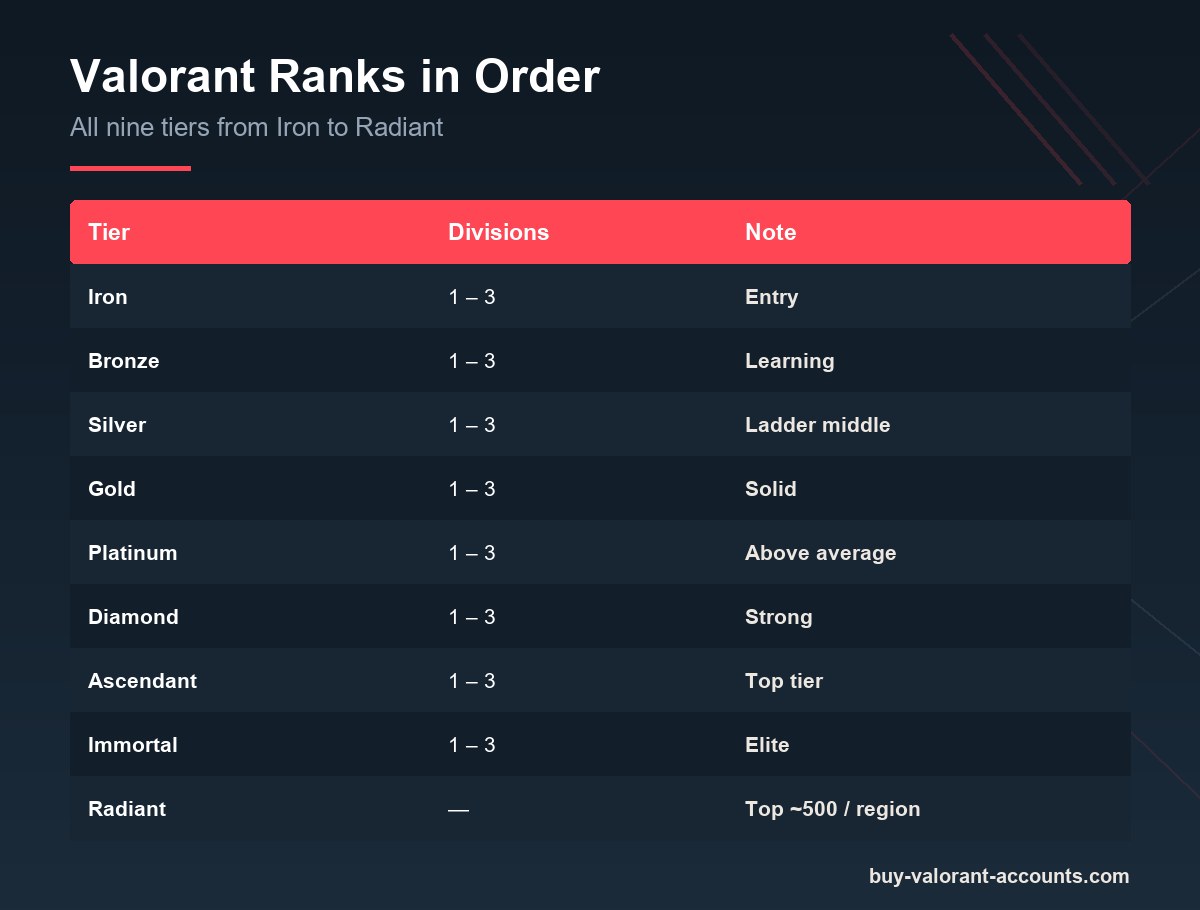
- Valorant has nine ranks: Iron, Bronze, Silver, Gold, Platinum, Diamond, Ascendant, Immortal, and Radiant.
- Every tier except Radiant is split into three divisions (e.g. Silver 1–3), for 25 distinct steps on the ladder.
- Rank Rating (RR) runs 0–100 within each division; win games to gain RR, lose to drop, with your hidden MMR deciding how much.
- Radiant is capped at roughly the top 500 players per region — it is a leaderboard rank, not just a tier.
- Ranked resets happen with each new Act, and the ladder now sits inside a year-long Season instead of the old Episode format.
What are the Valorant ranks in order?
The Valorant ranks in order, from lowest to highest, are Iron, Bronze, Silver, Gold, Platinum, Diamond, Ascendant, Immortal, and Radiant. Ascendant sits between Diamond and Immortal and was added to give high-level players more room to climb before the Immortal squeeze.
Each of the first eight tiers contains three numbered divisions — Iron 1, Iron 2, Iron 3, and so on — while Radiant stands alone with no divisions. That structure creates 25 rungs in total. Your icon reflects both the tier and the division, so a "Gold 2" badge tells another player almost exactly where your MMR sits.
If grinding through those divisions from scratch isn't how you want to spend your evenings, some players simply start higher — you can browse the rank-ready accounts here and pick a tier that matches the lobbies you actually want to play in.
How does Rank Rating (RR) work?
Rank Rating is the point system inside each division, running from 0 to 100. Winning a match earns RR and losing costs it; hitting 100 promotes you to the next division, while dropping to 0 and losing again demotes you.
The amount you gain or lose is tied to your hidden MMR (matchmaking rating). When your MMR is higher than your displayed rank, wins pay out more RR and losses hurt less, because the system is pulling you toward your "true" level. Individual performance nudges the numbers at lower ranks, but from Ascendant upward, win or lose becomes the dominant factor.
What is Radiant and how hard is it to reach?
Radiant is the highest rank in Valorant and is reserved for roughly the top 500 players in each regional shard. Above a certain RR threshold in Immortal, the ladder switches to a leaderboard, and only the highest-ranked players hold Radiant at any given moment.
Because it is a fixed number of slots per region, Radiant is competitive in a way tiers are not: staying there means out-performing everyone below you, not just clearing an RR bar. For the vast majority of the player base, Immortal is already an elite achievement.
How do Act and Season resets work?
Ranked progress resets at the start of each Act. As of 2025, Valorant moved from the old "Episode" structure to a year-long Season made up of six roughly two-month Acts, with the calendar year serving as the season name.
Resets are soft: you play placement matches and land near — but usually a bit below — where you finished, so you re-earn the top of your range. There is also a larger reset roughly twice a year, which is why you'll notice the ladder feel heavier at certain points in the calendar. None of your cosmetics, Act Rank badges, or account progress disappear; only your active competitive standing is recalculated.
Which Valorant rank is "good"?
Rank distribution is shaped like a pyramid, so context matters more than the tier name. The bulk of the player base sits in Iron through Gold, which means reaching Platinum already puts you above the average player, and Diamond is genuinely strong.
| Tier | Roughly where it sits |
|---|---|
| Iron – Bronze | Learning fundamentals; the largest population |
| Silver – Gold | The statistical middle of the ladder |
| Platinum – Diamond | Above average; consistent mechanics and comms |
| Ascendant – Immortal | Top few percent; strong game sense |
| Radiant | Top ~500 per region |
Chasing a specific rank is more fun when the climb starts somewhere sensible. Plenty of players keep a second account seeded near their real skill level so placements aren't a slog — if that's you, it's worth comparing what a ready-made account offers before you commit weeks to re-grinding.
Frequently Asked Questions
How many ranks are there in Valorant?
There are nine ranked tiers and 25 total divisions. Eight tiers (Iron through Immortal) each split into three divisions, and Radiant sits on top with none.
What is the highest rank in Valorant?
Radiant is the highest rank. It is limited to approximately the top 500 players per region and works as a leaderboard rather than an open tier.
What does RR mean in Valorant?
RR stands for Rank Rating — the 0–100 progress points inside each division. You earn RR for wins and lose it for defeats, with your hidden MMR setting how much each result is worth.
Why did I rank down after an Act ended?
Act resets recalculate your competitive standing through placement matches. The reset is soft, so you usually land slightly below your previous rank and climb back through the divisions you already cleared.
Is Ascendant a new Valorant rank?
Ascendant was added between Diamond and Immortal to give higher-skill players more room to climb. It is now a permanent part of the nine-tier system.
Does buying a higher-ranked account skip the grind?
A higher-ranked or rank-ready account starts you in different lobbies, but your hidden MMR still adjusts to your actual performance over time. It changes your starting point, not your skill ceiling.