Everyone wants the flashy 30-kill Jett clip, but the agents that quietly win games in Iron through Gold are the ones that don't need a coordinated team to function. After a lot of solo-queue games, I've become convinced that pick choice matters less for the highlight reel and more for how much you can carry on your own.
Key Takeaways
- In low elo, self-sufficient agents outperform high-skill-ceiling picks because you can't rely on teammates to trade or use utility on cue.
- Strong, forgiving picks across roles: Phoenix and Reyna (duelists), Brimstone (controller), Killjoy and Sage (sentinels), and Gekko (initiator).
- The common thread is independence — self-heals, self-flashes, easy-to-aim smokes, and utility that works even if nobody communicates.
- Agent meta shifts every patch, but these picks stay reliable because their value doesn't depend on team coordination.
- Climbing is still driven by fundamentals — crosshair placement, using utility, and playing for the round — more than by which agent you lock.
Why do self-sufficient agents win in low elo?
Self-sufficient agents win in low elo because coordination is the scarcest resource at those ranks. In Iron through Gold, teammates often won't trade your death, follow up a flash, or play off your smokes — so agents that create value alone are worth far more than agents that need a set-up.
That's the lens for everything below. A pick with a sky-high skill ceiling but heavy team reliance (think complex initiators or lurk-dependent controllers) tends to underperform in solo queue, while a "boring" agent who can flash, entry, and refrag by themselves carries games.
Which are the best agents for climbing low elo?
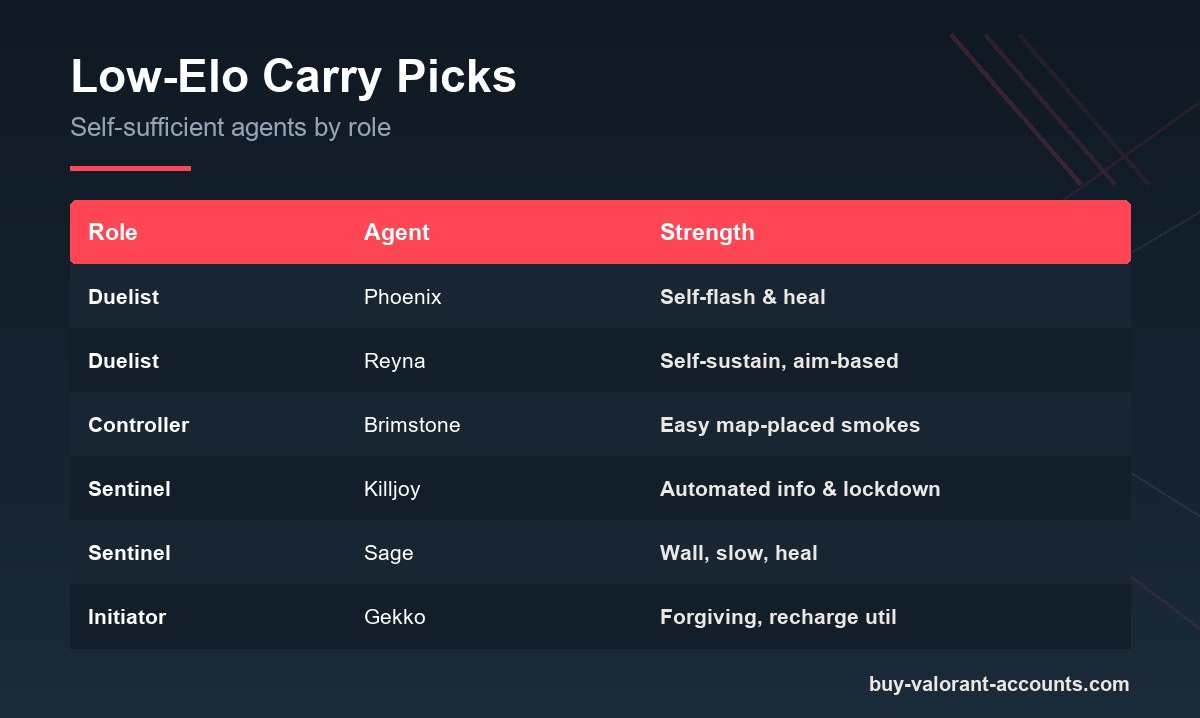
The strongest climbers cover every role, so you can fill whatever your team is missing. Meta tier lists move around each patch, but these picks stay dependable:
| Role | Agent | Why it carries solo queue |
|---|---|---|
| Duelist | Phoenix | Self-flash, self-heal, and a second-life ultimate — never needs a teammate to bail him out |
| Duelist | Reyna | Self-heal and dismiss reward raw aim; snowballs hard when you're winning fights |
| Controller | Brimstone | The most beginner-friendly smokes in the game — placed from the map, no line-of-sight guesswork |
| Sentinel | Killjoy | Automated turret and alarmbot hold flanks and gather info without any comms |
| Sentinel | Sage | A wall, a slow, and a heal make her useful even when the team is falling apart |
| Initiator | Gekko | Forgiving, rechargeable utility; his Wingman can plant or defuse the Spike when nobody else will |
If you want to practice these without dragging your main's rank through the learning curve, a fresh account seeded near your real skill level is a low-stakes place to grind reps — you can pick up a ready-made smurf account and learn a new role in lobbies that won't punish your main's RR.
How do you actually climb with these agents?
The agent gets you in the door; habits do the climbing. Four things move the needle more than your pick:
- Crosshair placement. Keep it at head height and pre-aim common angles. This single habit wins more low-elo duels than any ability.
- Use your utility every round. Unused flashes and smokes are wasted RR. Even imperfect utility beats holding it "for later."
- Play for the round, not the frag. Trading, planting, and saving win games; chasing kills loses them.
- Duo when you can. One reliable partner to trade with covers the exact weakness low-elo teams have.
Lock a small pool — one comfort pick per role — and you'll rarely be forced onto something you can't play.
Frequently Asked Questions
What is the easiest agent to climb with in Valorant?
Reyna and Phoenix are frequently recommended because their kits reward individual aim and let them heal and reposition without help. Brimstone is the easiest choice if you'd rather play a supportive smoker.
Does agent choice actually matter for ranking up?
It matters less than fundamentals. A comfortable, self-sufficient agent removes friction, but crosshair placement, utility usage, and round discipline decide most low-elo games.
Should I main one agent or play several?
Keep a small pool — ideally one solid pick per role — so you can fill your team's gap without being forced onto an agent you don't know. Mastering two or three beats dabbling in ten.
Are these picks still good after a patch update?
The specific tier list shifts each patch, but agents chosen for independence tend to stay strong, because low-elo lobbies keep lacking coordination no matter the meta.
Is it worth practising on a second account?
A separate account is a common way to learn a new role or agent without risking your main's rank. Just make sure any account you buy is on your region and comes with full access.